Papers and Preprints
-
Non-Elliptic Quadratic
 -symmetric Operators and Similarity to Self-Adjoint Operators
Submitted, 2026. pdf. -
Harmonic Approximation and Resolvent Estimates for Non-Self-Adjoint Operators
Submitted, 2026. pdf. -
Anderson Localization of Walking Droplets
Physical Review X, 14(3), 031047, 2024. pdf.
Research Summary
Research Interests: Semiclassical Analysis, Microlocal Analysis, Spectral Theory
Background and motivation: What is semiclassical analysis?
Selected Projects
Harmonic Approximation and Resolvent Estimates for Non-Self-Adjoint Operators
We study resolvent estimates and bounds on the low lying spectrum for a broad class of non-self-adjoint non-elliptic  -pseudodifferential operators with critical points. Imposing dynamical conditions on the average of the real part of the principal symbol along the Hamilton flow of the imaginary part, we establish precise semiclassical resolvent estimates in an
  -neighborhood of the boundary of the semiclassical pseudospectrum, away from the eigenvalues of quantizations of the quadratic approximations of the principal symbols of the operators.
Given a Hilbert space  and a self-adjoint linear operator
  the formula
![\[\text{dist}(z, \text{Spec}(P))^{-1} = \|(P-zI)^{-1}\|\]](https://www.stepanmalkov.com/wp-content/ql-cache/quicklatex.com-ea723e77a3d11125fc29600ccf7bf7a6_l3.png "Rendered by QuickLaTeX.com")
 and resolvent
  In contrast, in the non-self-adjoint semiclassical setting, the norm of the resolvent
  may grow exponentially as
  even when
  is at a fixed positive distance away from the spectrum. The region exhibiting such exponential growth yields the generalized notion of an operator’s pseudospectrum and underlies the phenomenon of spectral instability for non-self-adjoint operators.
For a complex-valued symbol  such that
  is elliptic at infinity, the spectrum of its Weyl quantization
  lies in the region
  and is purely discrete in the region
  However, the most relevant spectral region to the strongly continuous evolution semigroup
  is the low-lying spectral region
  Consequently, it becomes natural to study resolvent bounds and the eigenvalues of
  in this region.
Since the foundational work of Johannes Sjöstrand, the theory of elliptic quadratic differential operators has become a well-known tool in the theory of partial differential equations. It shows that given a complex-valued elliptic quadratic form  with positive definite real part, the spectrum of
  is purely discrete and consists of a lattice of eigenvalues in an angular sector in the right half-plane. Even when
  is positive semi-definite, Hitrik and Pravda-Starov proved the same result under a certain partial ellipticity condition on
  If
If  is the unique nondegenerate global minimum of
  and
and  is its Taylor expansion at the origin, one may then relate the low-lying spectrum of to the semiclassically-scaled spectrum of its quadratic approximation
This work proves new resolvent estimates for non-self-adjoint non-elliptic -pseudodifferential operators in the low-lying spectral region and localizes the low-lying spectrum to an -neighborhood of  Crucially, we allow
  to be non-discrete, introducing a finiteness assumption on the set of critical points of with purely imaginary values and restoring ellipticity via dynamical conditions on the averages of and along the respective Hamilton flows of their imaginary parts.

Decay Estimates for the Haldane-Lieb Hamiltonian
We analytically derive the exponential decay properties of bound gap states for the Haldane-Lieb topological lattice model. By means of a radial ansatz, we explore the asymptotic behavior of linear eigenstates using classical shooting methods and power series expansions. Moreover, we apply resolvent decay estimate methods to the nonlinear Haldane-Lieb operator in order to derive exponential-type L2 bounds on nonlinear eigenstates. Finally, we numerically confirm the qualitative features of the radial ansatz using a self-consistent iteration method, justifying the use of model linear systems for studying the decay properties of the nonlinear Haldane-Lieb system.
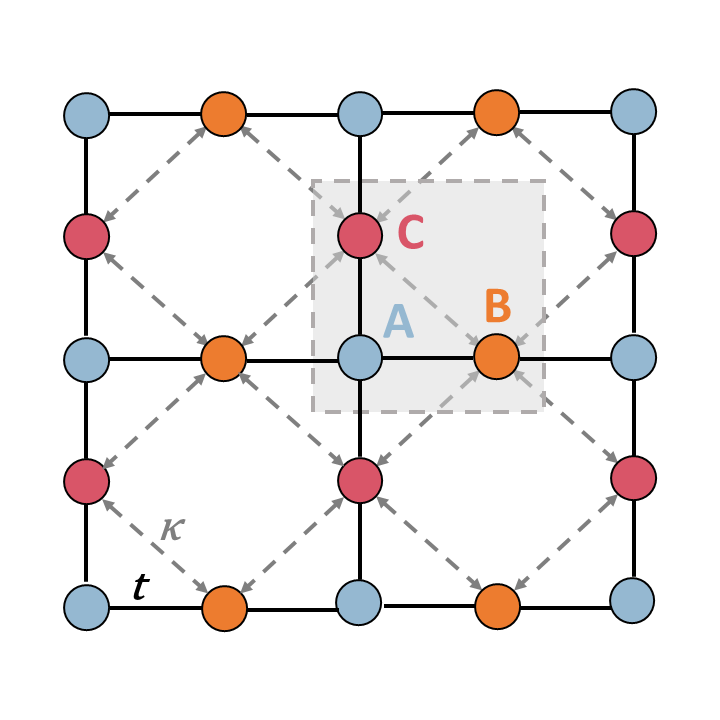
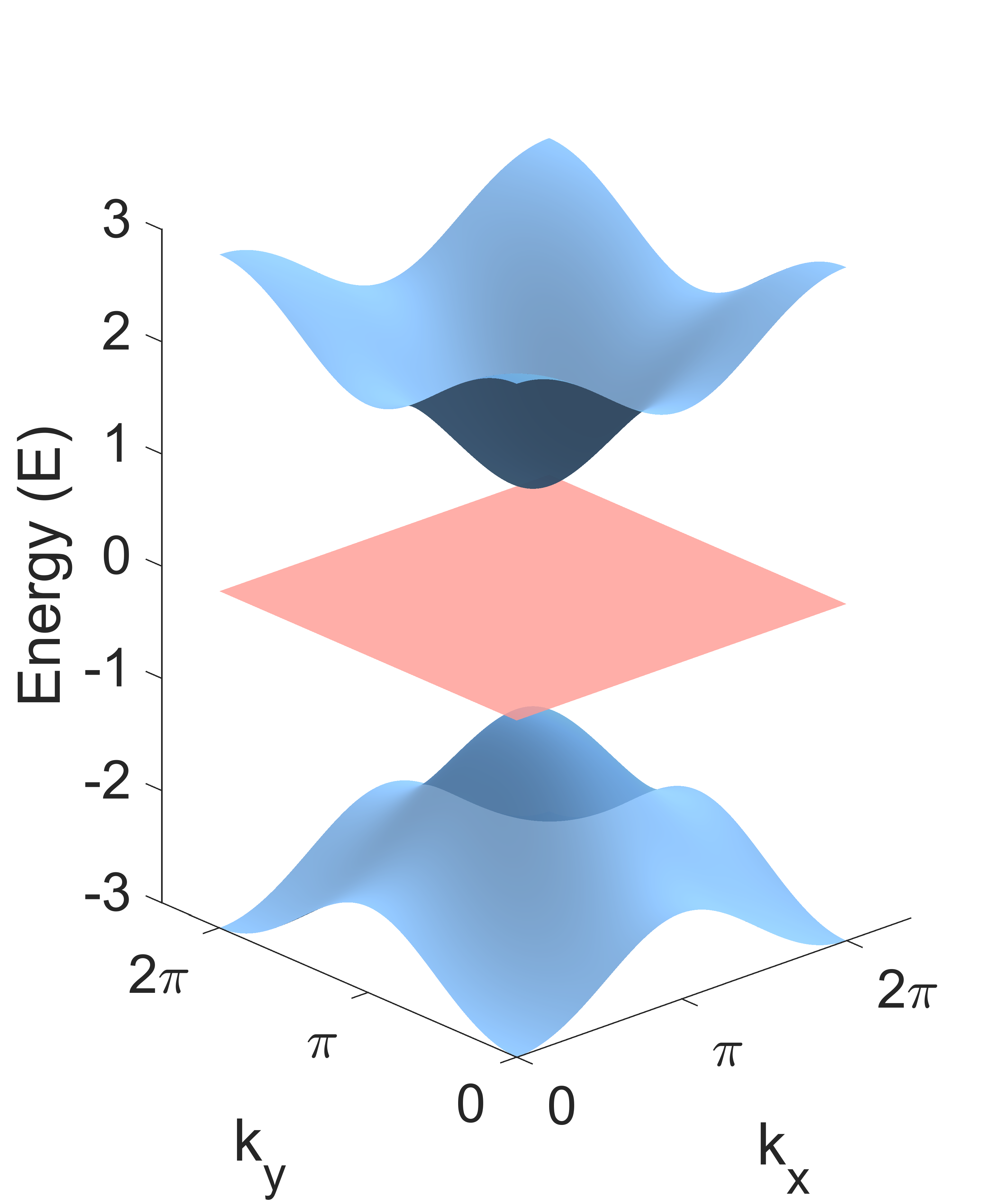
One of the biggest modern advancements in solid-state physics is the discovery of certain topological properties of quantum systems that directly characterize behavior. Such topological phenomena, such as the well-known the Quantum Hall Effect (QHE), crucially depend on the range of possible energies of a system, known as the system’s spectrum. In particular, if we consider the Lieb lattice (shown on the right), its spectrum is characterized by a topological band gap, a range of forbidden energies.
Yet, if one adds forcing to the system in the form of a nonlinearity, one is able to obtain solutions inside the gap, forcing them to decay exponentially at infinity. By relying on spectral techniques, we are able to show exponential decay of nonlinear states on the Lieb lattice, with decay rate directly proportional to the distance from the edge of the gap. Moreover, by a suitable ansatz, we are able to obtain a coupled system of ODEs, which we analyze using classical shooting techniques. Finally, we use numerical methods to predict the structure of linear and nonlinear states and justify the radial ansatz for the nonlinear system.
This work was completed as part of a senior honors thesis under the mentorship of Prof. Jeremy Marzuola at UNC-Chapel Hill.
Anderson Localization
joint with Abel J. Abraham, Frane A. Ljubetic, Matthew Durey, and Pedro. J. Sáenz
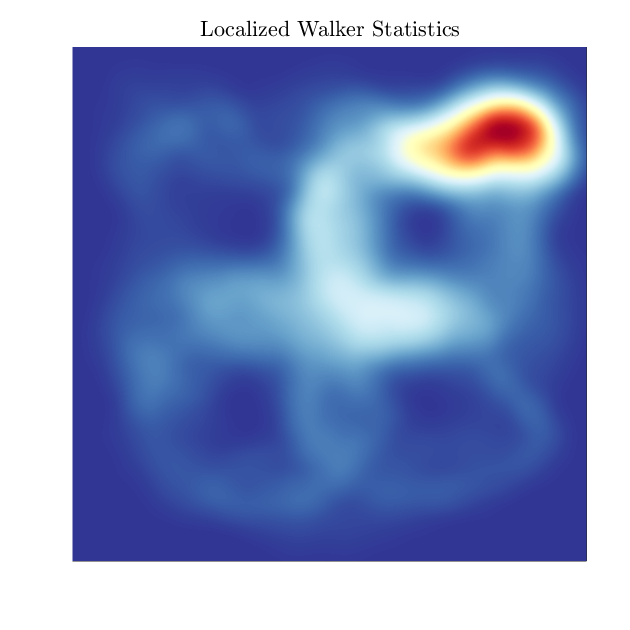
Understanding the ability of particles to maneuver through disordered environments is a central problem in innumerable settings, from active matter and biology to electronics. Macroscopic particles ultimately exhibit diffusive motion when their energy exceeds the characteristic potential barrier of the random landscape. In stark contrast, wave-particle duality causes electrons in disordered media to come to rest even when the potential is weak—a remarkable phenomenon known as Anderson localization. Here, we present a hydrodynamic active system with wave-particle features, a millimetric droplet self-guided by its own wave field over a submerged random topography, whose dynamics exhibits localized statistics analogous to those of electronic systems. Consideration of an ensemble of particle trajectories reveals a suppression of diffusion when the guiding wave field extends over the disordered topography. We rationalize mechanistically the emergent statistics by virtue of the wave-mediated resonant coupling between the droplet and topography, which produces an attractive wave potential about the localization region. This hydrodynamic analog, which demonstrates how a classical particle may localize like a wave, suggests new directions for future research in various areas, including active matter, wave localization, many-body localization, and topological matter.
One of the characteristic features of classical particle models is the prominence of diffusive behavior. An individual particle’s behavior in a random potential  exhibits Brownian motion, and the distribution of an ensemble of particles evolves according to the diffusion equation
 ![u_t(x,t) = \nabla \cdot [V(x) \nabla u(x,t)].](https://www.stepanmalkov.com/wp-content/ql-cache/quicklatex.com-1b8c784cda3d54b882054f208fddaf5f_l3.png "Rendered by QuickLaTeX.com")
In stark contrast to the classical case, quantum wavefunctions evolving according to the Schrödinger equation are able to demonstrate a lack of diffusion in sufficiently disordered potentials, a phenomenon known as Anderson localization. We demonstrate that such behavior can be rationalized through a classical wave-particle model known as walking droplets, showing localization of walker statistics highly reminiscent of Anderson localization in a bath containing a submerged disordered topography.
By combining experiments and simulations, we show that the walker, which is propelled by its own wavefield over the submerged topography, “prefers” a particular region of the topography, which is characterized by a peak in its trajectory histogram, bearing a notable resemblance to the dominant eigenmode of the Schrödinger equation for the same potential. Moreover, we suggest a mechanism for walker localization driven by the nonlocal interaction of the underlying waves guiding the droplet.
The proposed hydrodynamic quantum analogue opens up novel and interesting connections between classical physics and the underlying wave-particle duality of subatomic particles, suggesting other quantum phenomena, such as the Aharonov-Bohm effect, as potential directions for future research.
UPDATE 11/24:
Our paper has been published in Physical Review X!
This research is conducted in affiliation with the Physical Mathematical Laboratory (PML) at UNC-Chapel Hill.