The field of semiclassical analysis originated in the early 20th century as a way to translate between the mathematical formulations of classical and quantum mechanics. Motivated by the various similarities and parallels between classical systems and their corresponding quantum analogues, it attempted to formalize the correspondence principle, which states that the behavior of quantum systems should reduce to the laws of classical mechanics (in essence, Newton’s laws) at large enough physical scales. The scale of the system can be controlled by the semiclassical parameter  and classical behavior is recovered in the semiclassical limit
By this point, classical mechanics had been already effectively described using the Hamiltonian formalism, which interprets the laws of motion for the position  and velocity
  of a system as a flow
  in phase space associated to the total energy or Hamiltonian
  This flow is generated by the Hamiltonian vector field of
  and is described by Hamilton’s equations
![\[x'(t) = \xi(t), \quad \xi'(t)=-x(t).\]](https://www.stepanmalkov.com/wp-content/ql-cache/quicklatex.com-56c9aa33feb7b54e3d9c1b2f6b573903_l3.png "Rendered by QuickLaTeX.com")
 and its evolution is governed by the Schrödinger equation
 ![\[\psi_t = (-h^2 \Delta + V(x))\psi.\]](https://www.stepanmalkov.com/wp-content/ql-cache/quicklatex.com-f4da8c01eef42ede22119b7a4a1034aa_l3.png "Rendered by QuickLaTeX.com")
 One of the major insights was to relate the evolution of classical observables (known as symbols) and the corresponding quantum observables through a process known as quantization. The most well-known such map is the semiclassical Weyl quantization, defined for a symbol
  as the Fourier integral operator
 ![\[a^w(x,hD)u(x) = \frac{1}{(2\pi h)^n} \int_{\mathbb{R}^{2n}} e^{\frac{i}{h}(x-y)\cdot \theta} a\left(\frac{x+y}{2},\theta\right)u(y)dy d\theta.\]](https://www.stepanmalkov.com/wp-content/ql-cache/quicklatex.com-2936a5099aa98b137e6815a75d5a63ce_l3.png "Rendered by QuickLaTeX.com")
 the operator
  replaces every instance of
  with the semiclassical derivative
 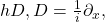 and is hence known as a pseudodifferential operator. This definition directly links the classical and quantum pictures — for instance, the Weyl quantization of the harmonic oscillator
  becomes the quantum harmonic oscillator
  and the Schrödinger operator
  itself becomes the quantization of the classical Hamiltonian
  This allows us to study eigenvalue and evolution problems for partial differential equations, including those outside quantum theory, using the geometric and dynamical behavior of their corresponding symbols.